Quick answer
Begin with a radial piston motor when the duty needs high starting torque, controlled very-low-speed output or sustained heavy loading. Begin with an orbital motor when compact size, simple installation and moderate torque are more important. The selected model limits still govern the decision.
Working principle and structure
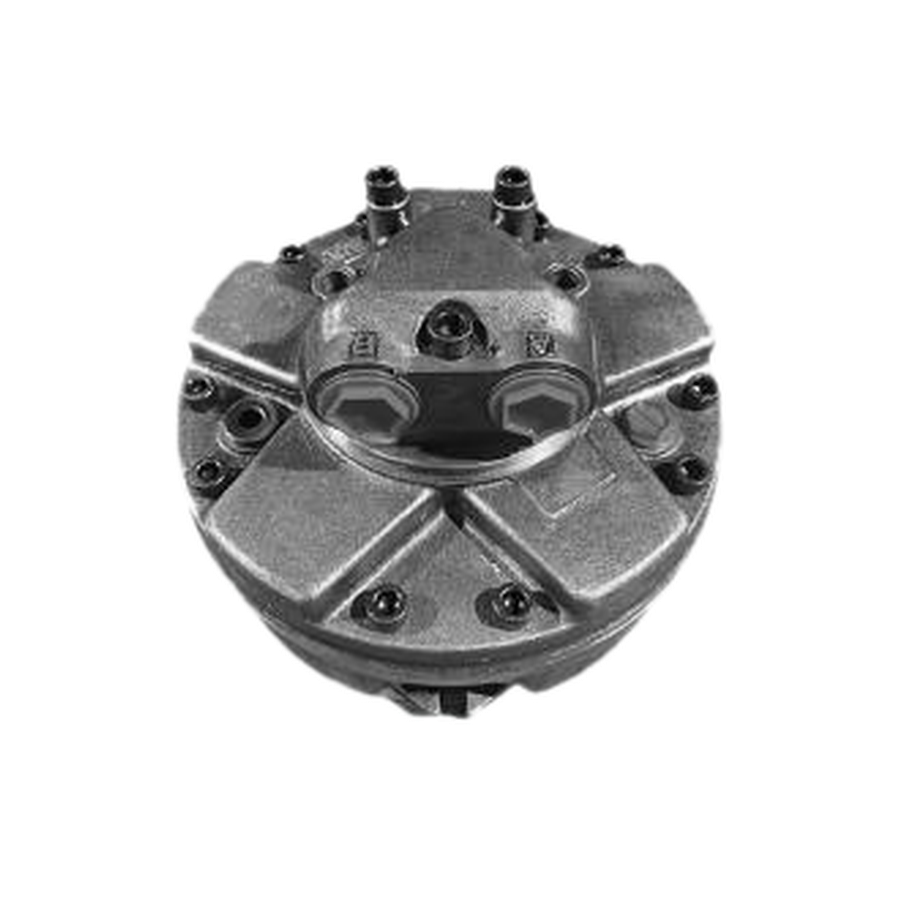
A radial piston motor uses pistons arranged radially around the shaft or cam ring. Hydraulic pressure acts on the pistons to create torque. An orbital motor, also called a gerotor or geroler motor, uses an internal gear set to convert flow into rotation.
Torque and starting performance
Radial piston designs are common in winches, heavy rotary drives, drilling equipment and deck machinery that start under load. Orbital motors fit many conveyors, sweepers, augers, reels, small winches and auxiliary drives where the required torque is moderate.
Speed range and smoothness
Very slow rotation under heavy load often favors a radial piston structure. Orbital motors are practical in compact mobile applications, but the minimum stable speed must be checked for the actual model and load.
Efficiency and duty cycle
Continuous heavy duty, shock loading and high downtime cost may favor a radial piston starting point. Light-to-medium intermittent duty and packaging or cost constraints may favor an orbital motor. Neither structure should be approved without checking the specific performance table.
Typical application comparison
| Application | Common starting point | Reason |
|---|---|---|
| Marine or mooring winch | Radial piston | Starting torque and heavy low-speed duty |
| Wheel, final or crawler drive | Radial piston or matched drive unit | Torque density and package integration |
| Conveyor, auger, sweeper or reel | Orbital | Compact moderate-duty package |
| Agricultural attachment | Orbital | Simple mounting and broad configurations |
| Heavy industrial rotary drive | Radial piston | Controlled output under load |
Selection data to confirm
- Continuous, peak and starting torque
- Normal speed and minimum controllable speed
- Available pressure, flow and return conditions
- Duty cycle and starts per hour
- Flange, shaft, ports and installation space
- Brake and valve functions
- Environment, contamination and maintenance access
How JST reviews the choice
JST supplies QJM, JNM and JHM radial piston motors plus BM orbital motors. Send torque, speed, pressure, flow and interface data so the comparison is made from the duty rather than forcing one structure into every project.
Frequently asked questions
Is a radial piston motor always better?
No. It is a common choice for heavier low-speed duty; an orbital motor can be better when packaging, simplicity and moderate torque matter more.
Can an orbital motor replace a radial piston motor?
Only after checking starting torque, duty, pressure, minimum speed and interfaces. Similar displacement alone does not prove interchangeability.
What information is needed?
Send torque, speed, pressure, flow, mounting, shaft, ports, duty-cycle and application drawings.
Continue with the complete LSHT motor selection guide or the winch motor guide.
Technical information is provided for preliminary selection. Confirm the selected model, installation and application requirements before ordering.